

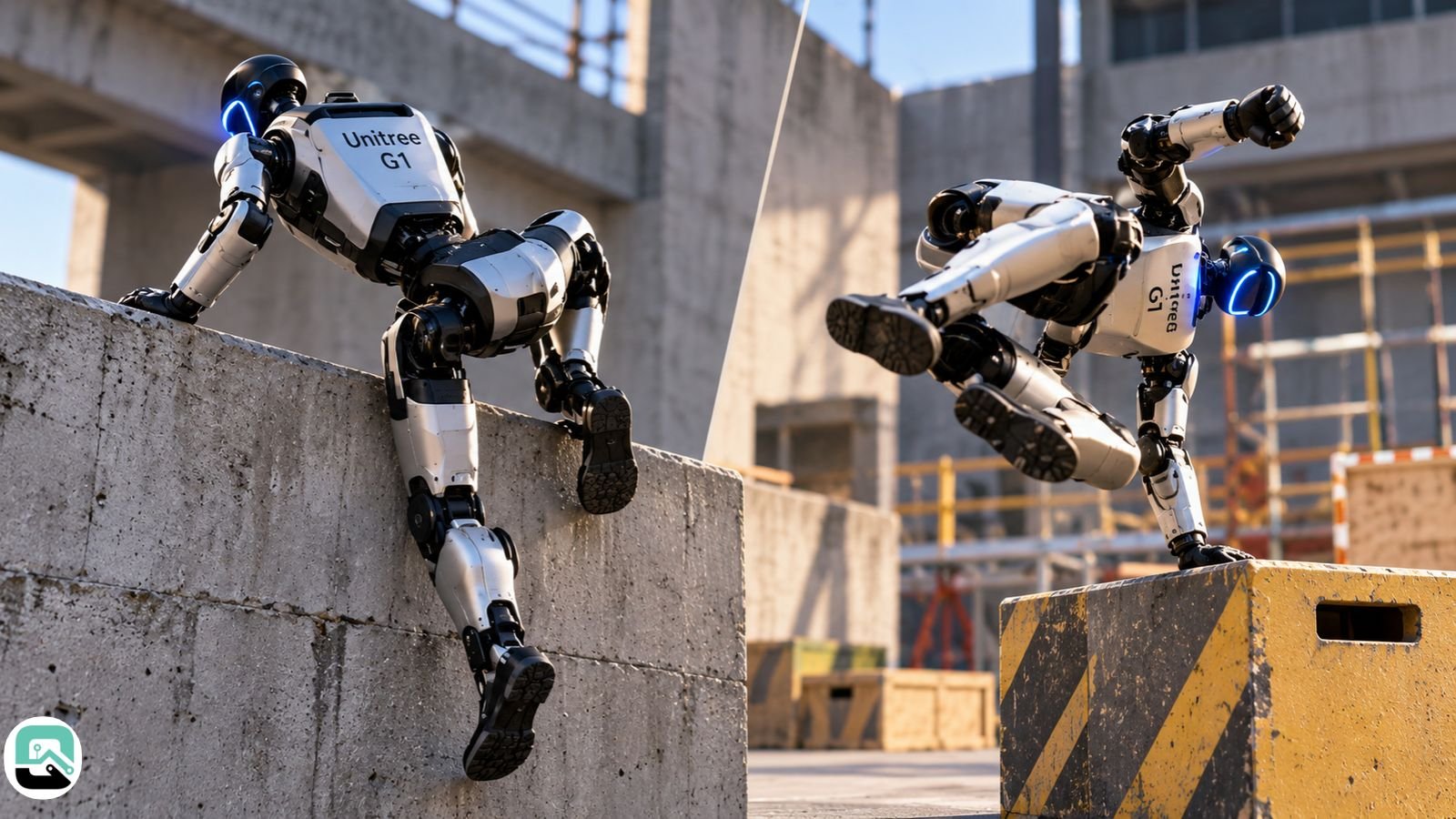
Most humanoid demos stay on flat floors. A team at ETH Zurich picked harder ground. Their robot climbs ladders, vaults obstacles, crawls through tight gaps, and gets back up after a fall. One learned policy handles all of it.
The system is called Attention-based Contact Planning (ACP). The researchers ran it on Unitree’s G1 humanoid and published the details on the ACP project page.
The problem with scripted movement
Whole-body control is hard, and the two usual approaches each fail differently.
Reinforcement learning lets a robot improve through repeated attempts. It struggles to coordinate a full body on complex tasks. Motion imitation teaches a robot to follow recorded movements. It struggles when the obstacle looks unfamiliar.
Many systems also generate a complete movement sequence and then track it. That works until the terrain stops matching the plan.
Planning touches, not motions
ACP changes the question. A planner chooses where the robot should touch its surroundings. A separate controller then moves the joints to make that contact.
On a ladder, the planner picks a rung for each hand and foot. The controller coordinates the arms, legs, and torso to reach them. No fixed climbing routine exists.
The lead researcher, C. Zhang, described the stack as a general contact planner, a general tracker, and a neural mapping, all warm-started from a small amount of human data.
Climbing is one piece of a broader run of humanoid mobility breakthroughs across 2025 and 2026.
Nine contact points
The planner controls nine body parts: both hands, elbows, knees, and feet, plus the pelvis. Most walking robots rely on their feet alone. This one braces with its upper body when its legs fall short.
That choice draws directly on human anatomy, the starting point for most humanoid robot design. People use knees and elbows without thinking when they crawl or scramble. ACP gives a robot the same option.
An attention-based neural network feeds the planner. It reads terrain data, joint positions and velocities, body orientation, and a goal from the user. The robot needs no reference motions at deployment.
Sensing thin rungs
Ladder rungs are narrow, and depth sensors often miss them. The team built a mapping system that turns LiDAR scans into a local height map. It also scores how reliable each reading is.
That reliability score matters. A planner that trusts bad data will reach for a rung that isn’t there.
The system runs on a Jetson Orin NX. A 20,000-point scan takes about 30 milliseconds, with updates at 10 Hz. That is modest hardware for this job.
Training on 13 minutes of human motion
Training ran in three stages:
- A whole-body controller learned to execute contact plans from 13.2 minutes of human motion data, adapted to the G1’s body and limits.
- The team trained the planner and controller together.
- Reinforcement learning pushed the system into procedurally generated terrain well beyond the demonstrations. Successful attempts became extra training data.
Thirteen minutes of human data is a small seed. Simulation grew it into a policy that generalizes across very different obstacles.
Results and limits
In simulation, ACP averaged a 92.5% success rate across eight composite obstacle courses. The baseline, a motion-generation-and-tracking method called MGMT, scored 58.8%.
Those figures come from simulation. The G1 also performed on real ladders, stairs, and stepping stones, and it crawled, vaulted, and recovered from falls. The reported numbers don’t include a real-world success rate.
The team names clear limits. ACP currently handles terrain contact and local movement toward a goal. Overhead contacts, hanging, and manipulation would need richer 3D perception.
What to watch next
Two questions will decide how far this goes.
The first is transfer. Simulation scores only matter if they hold on dusty rungs, worn stairs, and sensor noise. Real-world success rates would answer that.
The second is scope. A robot that climbs but can’t grab overhead or manipulate objects still has gaps. The researchers say richer 3D perception is the missing piece.
Why it matters
Tesla, Figure AI, Agility Robotics, and Boston Dynamics collect most of the humanoid headlines. Unitree, the G1’s maker, also ranks among the top humanoid robot companies by shipments and funding.
Yet the real test for any humanoid is a building that was never designed for it. Disaster sites, older plants, and crawlspaces all fit that description. A robot that plans contact instead of replaying motion has a better chance of handling the surprises.
Related: Free Humanoid Robot CAD Files: 6 Best Downloads Compared