

The biggest humanoid mobility story of 2026 isn’t a faster sprint. It’s that robots began running, swapping batteries, and working full shifts without a human at the controls.
Over the past year, a humanoid set a half-marathon record, a robot fleet sorted packages on a days-long livestream, an industrial robot learned to swap its own battery, and a new safety design aimed to remove the fences around robots.
Most coverage blends three different things: what a company demonstrated, what a company promised, and what customers actually use. This article keeps them apart. Company-reported figures are labeled as company-reported.
One limit applies to everything below: public evidence of reliable, general-purpose humanoid work in unfamiliar homes is still limited.
You’ll get a five-part test for any mobility claim, the current state of speed, terrain, whole-body control, endurance, and safety, a comparison table of the leading robots, and a checklist for judging the next viral video.
What counts as a mobility breakthrough in a humanoid robot?
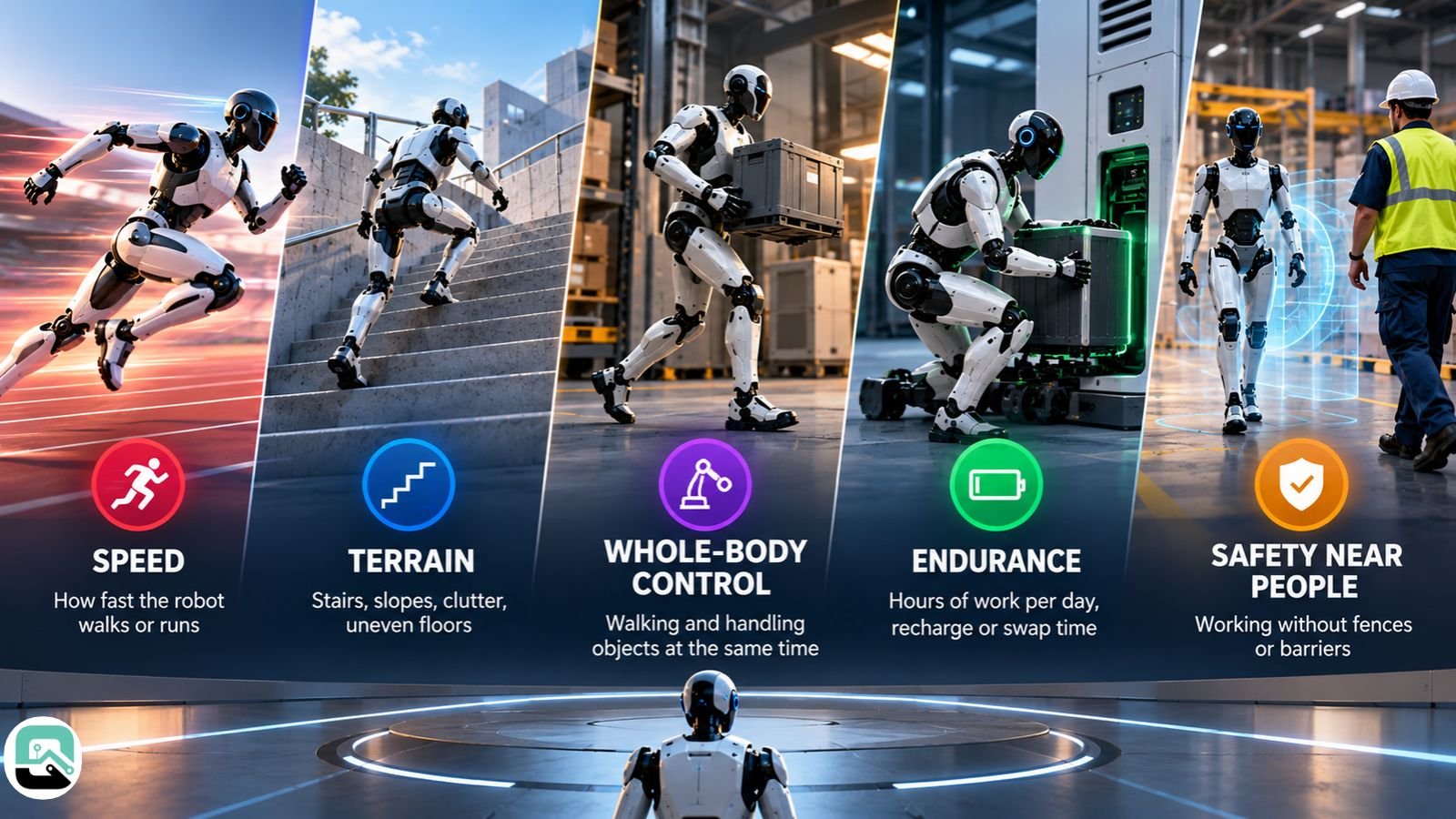
A humanoid mobility breakthrough is measurable progress in at least one of five areas. A single athletic video usually proves only the first. Real deployment needs all five.
| Dimension | What it measures | What a short video can’t show |
|---|---|---|
| Speed | How fast the robot walks or runs | Whether speed helps any real task |
| Terrain | Stairs, slopes, clutter, uneven floors | Performance on surfaces it never trained on |
| Whole-body control | Walking and handling objects at the same time | How often it fails over hundreds of attempts |
| Endurance | Hours of work per day, recharge or swap time | Behavior at hour six of a shift |
| Safety near people | Working without fences or barriers | Certified, audited results |
Search results reward spectacle, so this framing matters. A backflip proves dynamic balance. It doesn’t prove a robot can work an eight-hour shift, share an aisle with people, or repeat a task a thousand times.
If you’re new to how two-legged robots stay upright, our explainer on bipedal locomotion in humanoid robots covers the mechanics. The sections below sort each 2025–2026 development by which of the five dimensions it actually demonstrates.
What is the fastest humanoid robot in 2026?
The fastest officially scored humanoid half-marathon is 50 minutes and 26 seconds. Honors robot Lightning set that time at the Beijing E-Town Humanoid Robot Half-Marathon on April 19, 2026. That beat the men’s world record at the time, Jacob Kiplimo’s 57:20 from Lisbon in March 2026. Ethiopia’s Yomif Kejelcha has since run 56:51 in Buenos Aires in August 2026, and Lightning’s time is faster than that mark too.
The jump from 2025 is large. The previous year’s winner, Tiangong Ultra, needed 2 hours, 40 minutes and 42 seconds.
What the Beijing half-marathon record does and doesn’t prove
The race result needs three caveats:
- Two Honor robots, two categories. A remote-controlled Honor robot crossed the line first. The autonomous one took the champion title, according to Smithsonian’s report on the race. That robot ran 48:19, but race rules multiplied remote-controlled times by 1.2, giving it an adjusted 57:58.
- Most robots weren’t autonomous. Organizers said about 40% of the robots ran the course autonomously. The rest were remote-controlled.
- The course was pre-mapped and staffed. The route was fixed, and teams supported their robots along it.
The race shows fast, sustained bipedal running over 21 km.
Other humanoid speed claims
- Unitree G1: At the 2026 Spring Festival Gala, Unitree said its G1 robots performed a kung fu routine autonomously, with running speeds up to 4 m/s. That figure is company-reported. Our Unitree G1 review covers the robot’s specs and price.
- Figure 03: CEO Brett Adcock posted a December 2025 video of the robot approaching human jogging pace. That’s a company demo, not an independent test.
Speed is the most photogenic metric. It’s also the one least connected to useful work.
Can humanoid robots climb stairs and handle rough terrain?
Yes, in research settings, and faster than before. In 2026, humanoid stair climbing moved from slow, careful stepping to running. The catch: most results come from labs and competitions, not from customer sites.
Three 2026 results show where terrain mobility stands:
- Running up stairs. The FastStair method let LimX Dynamics’ Oli humanoid climb stairs at commanded speeds up to 1.65 m/s. In the FastStair research paper, the robot crossed a 33-step spiral staircase in 12 seconds. The same approach won the Canton Tower Robot Run Up Competition.
- Using hands and knees. Stanford’s “Locomotion Beyond Feet” system lets a humanoid crawl under chairs and climb knee-high walls and platforms. The robot uses hands, knees, and elbows for extra contact points, the way people do on awkward ground.
- Seeing in all directions. A March 2026 paper ran on a Unitree G1 and used LiDAR elevation mapping to remove the blind spots of forward-facing cameras. That lets the robot step safely on stairs while moving sideways or backward.
The shared method is reinforcement learning. Robots practice millions of attempts in simulation, then transfer the learned controller to hardware.
What stays unproven: performance on terrain the robot never trained on, and failure rates over thousands of steps in a real building. Not every maker bets on legs, either. Wheels are simpler and more efficient on flat warehouse floors, while legs earn their extra cost on stairs, steps, and spaces built for people. Our guide to types of humanoid robots compares the two.
Why does whole-body control matter more than walking?
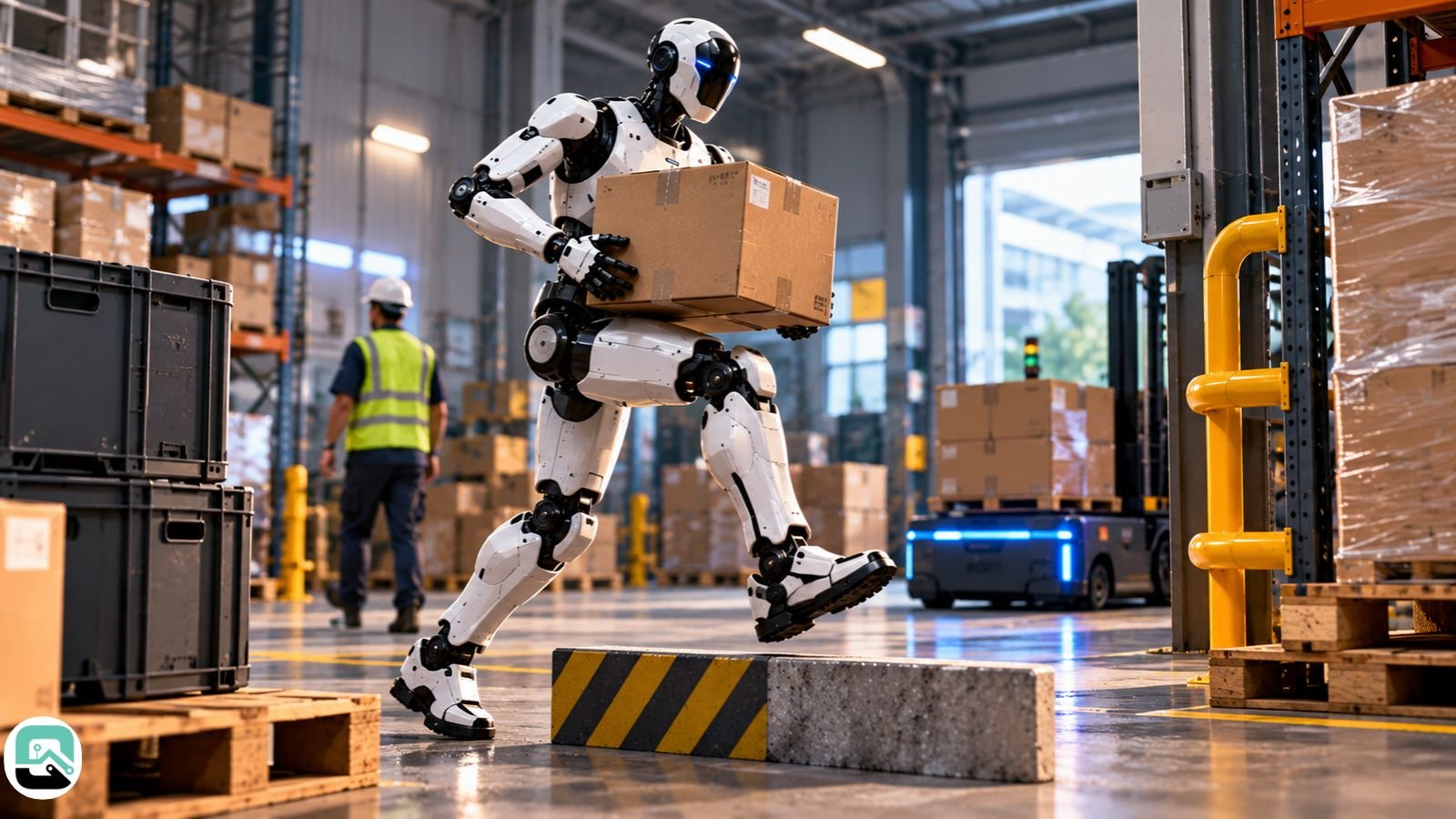
Basic walking on flat, known ground is well demonstrated on many robots. Robust walking around moving people, slippery floors, and surprises is not. The harder problem is walking, balancing, and handling objects at the same time. That’s whole-body control, and it decides whether a humanoid can do real work.
Figure’s Helix 02, unveiled in January 2026, is the clearest example. Helix 02 is a single neural network that controls the robot’s legs, torso, arms, and fingers together. Figure says its low-level controller, trained on more than 1,000 hours of human motion, replaced over 100,000 lines of hand-written C++ code.
What Figure has shown with Helix 02
- Kitchen task: A four-minute dishwasher unload-and-reload across a full kitchen, with walking, manipulation, and balance, and no resets. This is a company demo.
- Warehouse livestream: In May 2026, Figure set out to stream an eight-hour autonomous package-sorting shift. Three Figure 03 robots, rotating between work and charging, kept the stream running past 200 hours and roughly 249,560 sorted packages. The figure stated there was no teleoperation.
The livestream is stronger evidence than an edited clip, because anyone could watch it in real time. It still isn’t an independent audit, and 200 hours of stream time is fleet time, not one robot running nonstop. Figure hasn’t published error rates, intervention logs, or cost per hour. In a side-by-side 10-hour test during the stream, a Figure intern sorted slightly more packages than the robot fleet.
Figure’s earlier factory work is documented too. Figure 02 robots ran 10-hour shifts at BMW’s Spartanburg plant and handled more than 90,000 parts. Our coverage of the BMW Figure 03 deployment follows what came next, and the Figure 03 review covers the hardware.
Learned whole-body policies are expanding what humanoids can do in selected tasks, often alongside conventional control.
How long can a humanoid robot work before recharging?
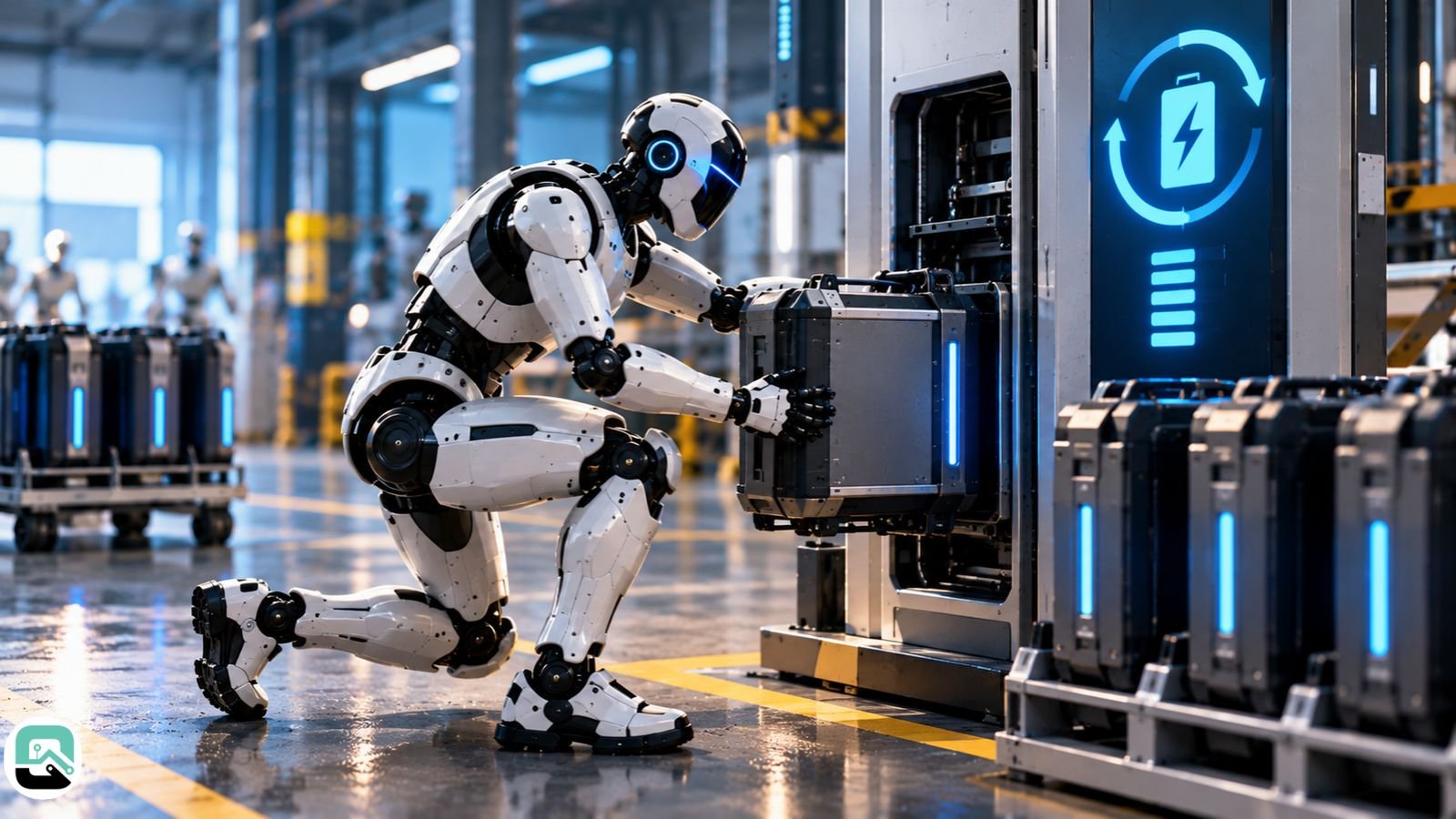
Most humanoids run about two to four hours per battery. In 2026, the improvement came from how robots refill, not from bigger batteries. Two approaches lead: swapping batteries and fast charging.
| Robot | Approach | Runtime and refill | Status |
|---|---|---|---|
| UBTech Walker S2 | Swaps its own battery at a dock | About 2 hours walking; swap in roughly 3 minutes | Hundreds delivered to industrial customers, per UBTech |
| Agility Digit 5 | Fast charging | 90 minutes of runtime; 9-minute charge; over 20 hours of work per 24 (Agility’s claim) | Early access planned for H1 2027 |
| Unitree H2 | Standard battery | About 3 hours | On sale |
Walker S2 carries two battery packs, so it stays powered during a swap, and it picks swapping or recharging based on its task. Digit 5’s 10:1 run-to-charge ratio compares with 2:1 on Digit 4. Neither company has published long-term fleet uptime data from customer sites.
Figure has added a hardware stress test. On October 19, 2026, CEO Brett Adcock said a Figure 03 had walked on a treadmill for nine straight days, covering 348 miles and 1.2 million steps. Footage in Interesting Engineering’s report shows a power cable attached, so the test measures joint and actuator durability, not battery life. Figure hasn’t published a test protocol or a log of interventions.
Are humanoid robots safe to work around people?

Not yet proven at scale. Safety is probably the real bottleneck for industrial humanoids, because a robot that can’t work near people stays behind barriers.
What Agility Digit 5 changes
Agility unveiled Digit 5 on September 15, 2026, as its first humanoid engineered for “cooperatively safe” work without physical barriers. According to Agility’s Digit 5 announcement, the safety design includes:
- Visual and audio cues that signal the robot’s next movement to nearby workers
- AI-based human detection using multiple sensor types
- An independent safety controller that triggers a response when a person comes too close
- The ability to stop, sit down, and power down its motors to reduce fall risk
“Cooperative” safety means sharing space while keeping a safe distance. It doesn’t mean handing parts directly to a person, which is a harder problem called collaborative safety.
Digit 5 also lifts to 50 lb, 40% more than Digit 4, and reaches 7.2 feet. Agility expects early access in the first half of 2027 and general availability by the end of 2027. The company reports more than $300 million in multi-year orders, but filings show those orders come from a single customer and depend on Agility meeting contract milestones.
Where humanoid safety standards stand
ISO 25785-1 is being developed as the first international safety standard for dynamically stable industrial mobile robots. Its scope covers bipedal, quadrupedal, and self-balancing wheeled robots in industrial workplaces, not homes. ISO’s listing for ISO/CD 25785-1 still shows it at the committee draft stage. Until it’s finalized, deployments rely on site risk assessments and existing industrial robot and machinery standards.
Agility does have one real-world data point. Digit was the first humanoid to pass an independent field evaluation on a customer production line against OSHA-administered industrial safety standards. Digit 5’s own certification results aren’t published yet, so “cooperatively safe” is still a design goal, not a verified outcome.
Which humanoid robots moved from demo to production?
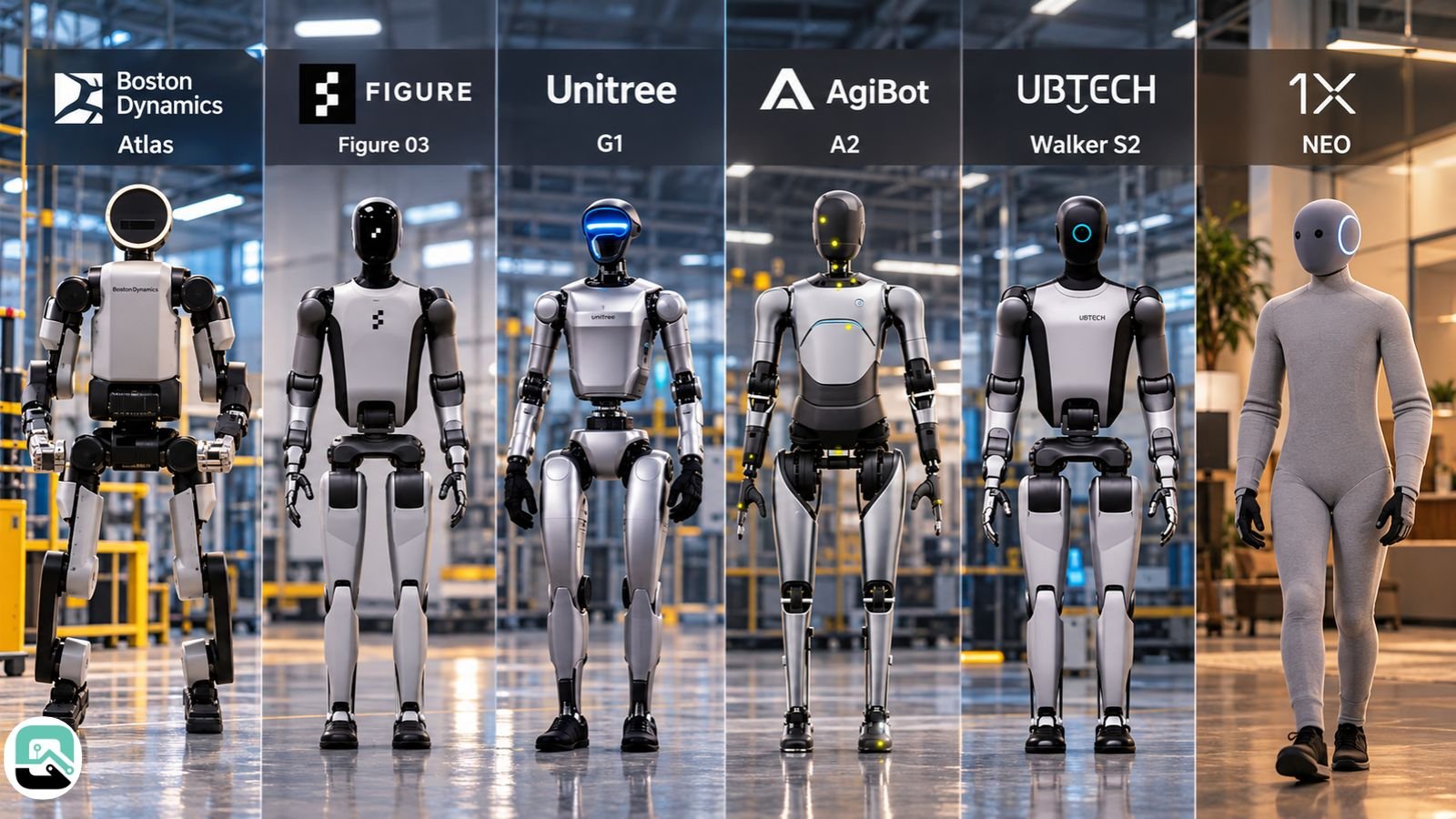
By October 2026, six makers had moved into series production or paid deployments: Boston Dynamics, Figure, Unitree, AgiBot, UBTech, and Agility. 1X has a factory running but no verified customer deliveries. Tesla has started early production but isn’t shipping outside Tesla.
Boston Dynamics Atlas: from showpiece to industrial product
Boston Dynamics unveiled the production version of its electric Atlas at CES on January 5, 2026, and started manufacturing right away. The Boston Dynamics says all 2026 units are committed to Hyundai’s Robotics Metaplant Application Center (RMAC) and Google DeepMind, with more customers planned for early 2027.
The CES Atlas has 56 degrees of freedom, tactile-sensing hands, 360-degree cameras, and a 110-pound lift capacity. It operates from –4°F to 104°F. Joint count alone doesn’t predict agility, a point our humanoid DOF explainer breaks down.
The limits matter more than the spec sheet:
- A prototype, not the commercial unit, performed the CES demo.
- Heavy lifting cuts battery life roughly in half.
- Boston Dynamics opened RMAC inside Hyundai’s Georgia Metaplant on September 21, 2026. Atlas is slated for parts sequencing there starting in 2028.
- No price has been published.
Atlas improved ruggedness and manufacturability, not general-purpose autonomy. Our electric Atlas review and analysis of Hyundai’s Atlas bet cover the business side.
Figure 03: the fastest production ramp in the US
The figure says its BotQ factory went from one Figure 03 per day to one per hour in under 120 days, with more than 350 robots delivered by April 29, 2026. Figure’s own post on ramping Figure 03 production calls the hourly rate a demonstrated cycle time. That’s not the same as running at that rate continuously.
Unitree and AgiBot: China’s volume leaders
Unitree shipped more than 5,500 humanoids in 2025, the most of any maker that year.
AgiBot has since taken the volume lead. Smart Analytics Global data puts AgiBot ahead of Unitree in the first half of 2026, with about 8,400 units (44% share) against Unitree’s 5,900 (31%). A large share of Unitree’s G1 volume goes to education, research, and performances, so shipment counts don’t equal factory work.
Unitree’s full-size H2 starts at $29,900 in China. International versions are listed higher, so check regional pricing before making purchasing decisions.
1X NEO: a factory, but no confirmed home deliveries
1X opened its NEO factory in Hayward, California, on April 30, 2026. NEO costs $20,000 for Early Access or $499 a month on a subscription. The first robots off the line went to 1X’s internal R&D and home-testing programs.
In our checks through late October 2026, we found no independently verified customer delivery. NEO can also get remote help from a 1X operator for tasks it can’t do alone, which is a privacy trade-off as much as a technical one.
Where does Tesla Optimus stand on mobility?
Tesla hasn’t shown the production-intent Optimus V3 in a public demonstration. Without that demo, any ranking that puts Optimus first on mobility is speculation.
On Tesla’s Q3 2026 earnings call on October 21, Elon Musk said early production has started in Fremont, with deliveries to outside companies expected around the end of 2027, according to the Q3 2026 call transcript. The V3 reveal has slipped from Q1 2026 to mid-2026 to no date at all.
Our Optimus Gen 3 review and guide on whether you can buy a Tesla robot follow the timeline.
Humanoid robot mobility compared: evidence by robot
No humanoid leads on all five mobility dimensions. The table rates each robot’s strongest claim by the quality of its evidence, from a company demo up to customer deployment.
| Robot | Strongest mobility claim | Evidence level | Availability (Oct 2026) |
|---|---|---|---|
| Agility Digit 4 / 5 | 65,000+ hours of commercial work (Digit 4); barrier-free safety design (Digit 5) | Customer-deployed (Digit 4); design goal (Digit 5) | Digit 5 early access H1 2027 |
| Figure 03 | 200+ hours of fleet package sorting; 348-mile treadmill test | Public livestream; company-reported | Delivered to commercial customers |
| Boston Dynamics Atlas | Rugged industrial build, 110 lb lift | Company-reported specs | 2026 supply committed to Hyundai and DeepMind |
| UBTech Walker S2 | Autonomous battery swap | Company-reported deliveries | Industrial orders, mainly China |
| Honor Lightning | 50:26 autonomous half-marathon | Public race result | Not for sale |
| Unitree G1 / H2 | Agile, dynamic motion at low cost | Company demos; high sales volume | On sale |
| 1X NEO | Home-focused general-purpose robot | Company demos | Preorders; no verified deliveries |
| Tesla Optimus V3 | Not yet shown | None public | External deliveries targeted ~end of 2027 |
Evidence reflects public information reviewed as of October 24, 2026. Manufacturer claims, controlled tests, research results, and customer deployments are treated as separate evidence types. A lack of public evidence doesn’t prove a lack of capability.
Agility’s long track record deserves a note. Digit 4 has logged more than 65,000 operating hours at sites including GXO, Schaeffler, Amazon, and Toyota. At GXO’s Flowery Branch facility, Digit 4 moved 100,000 totes at about 98% on-task accuracy. That’s the strongest publicly disclosed deployment record in the category, even if Digit is slower and less flashy than its rivals.
For head-to-head specs on any two robots, use the RoboPulse humanoid robot compare tool.
How to judge the next humanoid “breakthrough” video
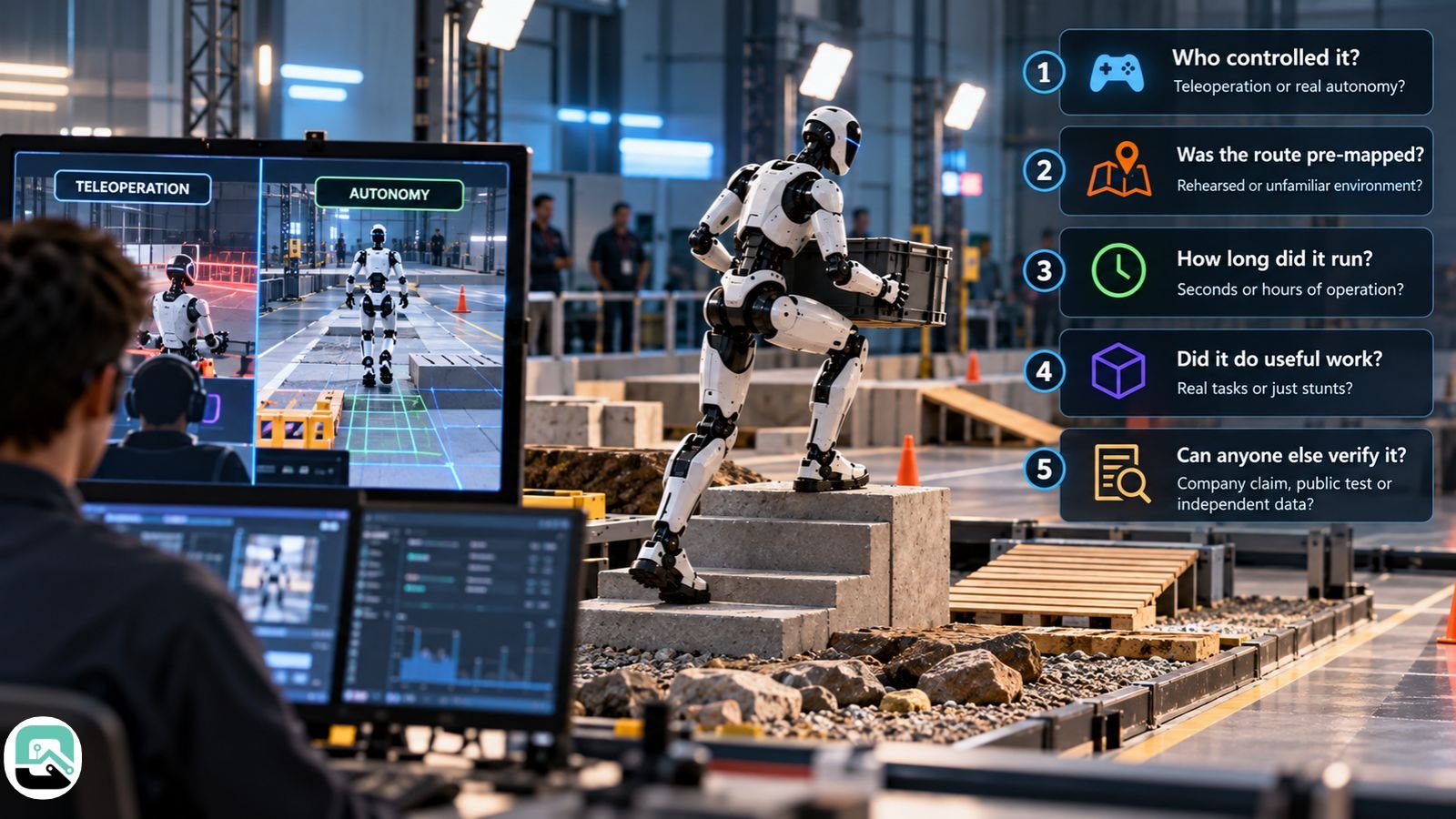
Ask five questions. Most viral clips fail at least two of them.
- Who controlled it? Teleoperation and autonomy look identical on video. In Beijing, autonomous and remote-controlled robots raced in separate categories for exactly this reason.
- Was the route or task pre-mapped? A fixed, rehearsed setting proves far less than an unfamiliar one.
- How long did it run? A 30-second flip says little about hours of operation. A multi-day public run says much more.
- Did it do useful work? Running and dancing show balance. Moving totes, parts, or packages shows value.
- Can anyone else verify it? Company-reported numbers sit near the bottom of the evidence ladder. Public livestreams sit higher. Independent tests, standards bodies, and customer disclosures sit at the top.
Watch for hidden humans, too. Remote operators can fill gaps in autonomy without the video showing them.
What would a fair humanoid mobility test look like?
A fair comparison holds the conditions constant across robots:
- Same route length, terrain, and payload
- Same battery state at the start
- No predefined map, or the same map for everyone
- Remote intervention either banned or counted
- Falls, recoveries, and downtime logged, not edited out
- Enough attempts to report a completion rate
Manufacturers rarely publish results under a shared protocol, so no one can honestly crown an overall mobility winner today. That may change. NIST has proposed a humanoid baseline performance benchmark of standardized locomotion and manipulation tasks, and plans to send test apparatus to US manufacturers and testing facilities.
Two numbers are rarely disclosed: how often a robot falls or needs a human reset, and what it costs per productive hour. Agility has put leasing a Digit 5 at about $8,500 a month, according to Interesting Engineering, but no maker publishes cost per hour of useful work. Until those figures appear, even a strong mobility demo can’t show that a robot pays for itself.
Humanoid robot mobility FAQs
Q. What is the most advanced humanoid robot in 2026?
No single humanoid leads on every measure. Honest Robotics’ Lightning leads on documented speed, Figure 03 on public autonomous work, Agility’s Digit on disclosed commercial hours, and Atlas on industrial build. Tesla’s Optimus V3 can’t be ranked until Tesla shows it.
Q. How many humanoid robots will ship in 2026?
Nobody has a verified full-year total. About 19,100 humanoids shipped worldwide in the first half of 2026, according to Smart Analytics Global. JPMorgan forecasts around 60,000 for the full year. Treat all full-year numbers as estimates.
Q. Can I buy a humanoid robot right now?
Yes, in limited cases. Unitree sells the G1 and H2, with the H2 starting at $29,900 in China. Atlas isn’t for sale to new buyers in 2026. 1X NEO preorders are open, but consumer deliveries haven’t been verified.
What humanoid mobility can and can’t do today
Humanoid mobility made real progress in 2026. Robots now run half-marathons, climb stairs at speed, swap their own batteries, and sort packages for days without teleoperation. Those are genuine gains in speed, terrain, endurance, and whole-body control.
Safety near people and reliability in unfamiliar spaces remain unproven. The best evidence still comes from structured settings: factory lines, warehouses, and pre-mapped race courses.
If you’re judging a robot, weigh customer hours and public, unedited runs above polished videos. By that standard, Agility and Figure have the strongest 2026 evidence.
Related: Humanoid Robot Operating Hours Per Day: What Real Deployments Reveal
| Disclaimer: This article is for informational and educational purposes only. Information about humanoid robot mobility breakthroughs, specifications, production status, pricing, and performance is based on publicly available research, manufacturer announcements, and demonstrations as of October 2026. Company-reported claims may not reflect independently verified real-world performance. Robot capabilities, availability, and safety standards may change over time. Readers should consult official manufacturers and independent testing sources for the latest verified information. |