

Forecasts for 2050 grab attention. The sharper question is which part of the robot each company wants to own.
Morgan Stanley’s published research projects a $5 trillion humanoid market by 2050, with more than 1 billion robots in service. The Motley Fool now cites a higher $7.5 trillion figure from the same bank. Morgan Stanley’s public research page lists $5 trillion, so treat the higher number as unconfirmed.
Both counts cover humanoids only. Autonomous equipment in warehouses, factories, and job sites would add to the total.
Big numbers produce lazy stock lists. The better lens is the robot itself.
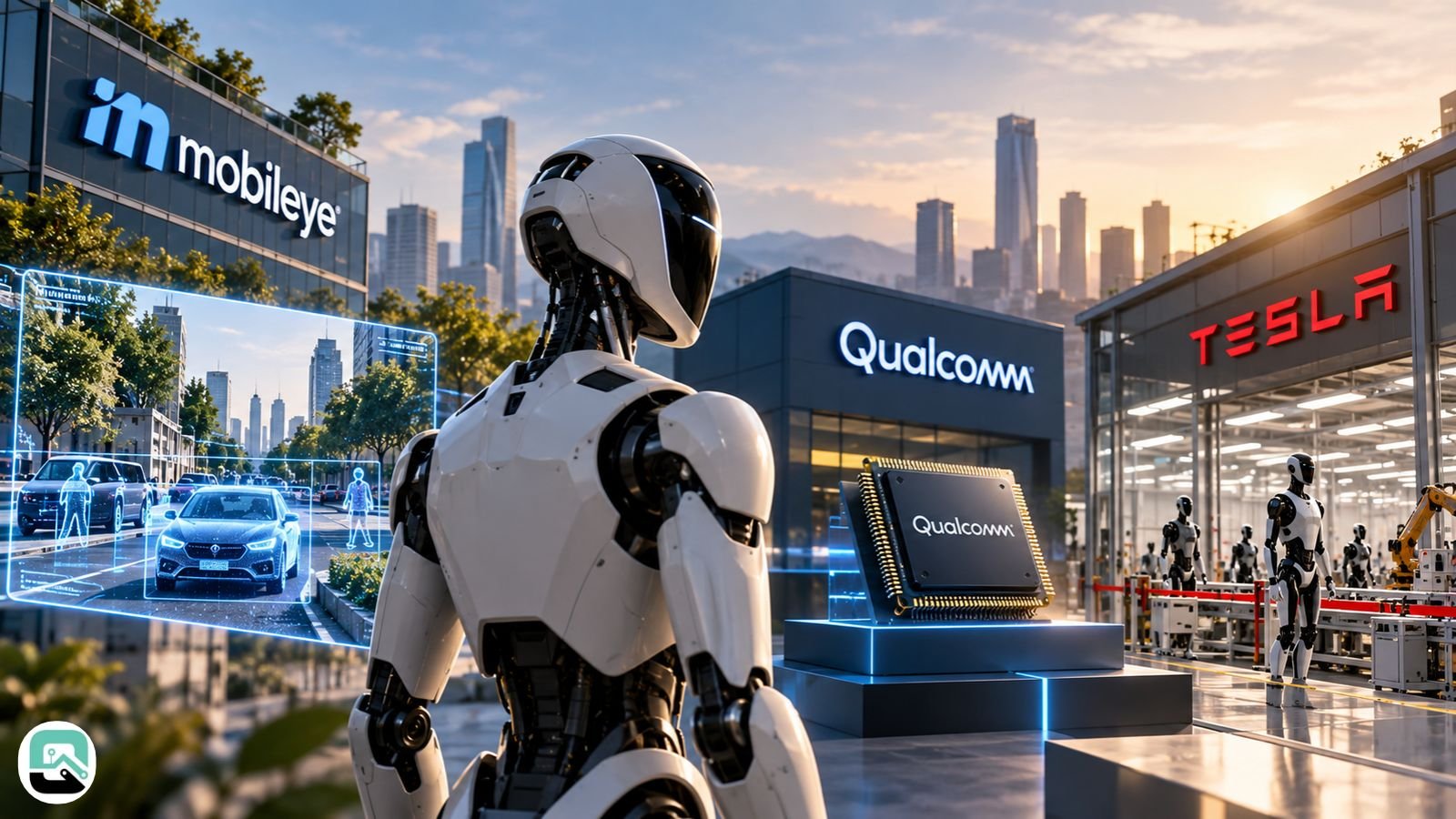
A humanoid has to read its surroundings, think fast enough to act, and roll off a production line at a price buyers can pay. Qualcomm Mobileye and Tesla each chase one of those jobs.
Mobileye wants to own judgment
Mobileye taught cars to see and decide. In January, it agreed to buy humanoid developer Mentee Robotics for $900 million, paid as $612 million in cash plus Mobileye shares. CEO Amnon Shashua co-founded Mentee and stepped aside from the board’s vote on the deal.
The pitch pairs Mentee’s 3D mapping with Mobileye’s reasoning about context and intent. Mentee will run as an independent unit and borrow Mobileye’s AI training infrastructure. Mobileye expects proof-of-concept deployments this year and commercialization in 2028. How the two stacks merge into one product remains open.
Investors haven’t cheered. Shares fell 9.21% on October 29 to $6.41, near the bottom of a 52-week range of $6.37 to $14.33.
At a market cap near $6 billion, the Mentee price equals about 15% of the company.
Qualcomm wants to own the nervous system
Robots that work in groups can’t wait on a distant data center for every decision. Qualcomm sells edge computing, which keeps the processing close to the machine.
The company built its name on Snapdragon processors for phones and AI laptops. Data center operators now use the same power-efficient design, and robotics is its next target.
In January, the company launched the Dragonwing IQ10 chip for humanoids and industrial robots. Figure, which builds a general-purpose humanoid already working in a BMW plant, is working with Qualcomm on its next compute architecture.
Other partners include Advantech, Kuka Robotics, Robotec.ai and VinMotion. Qualcomm doesn’t need to pick a winning robot maker. If its chips sit inside many machines, it profits whichever one wins.
Tesla wants to own the factory
Elon Musk says Optimus could become Tesla’s best-selling product, maybe the biggest product on Earth. Discount his schedules, since he often misses them even when the idea eventually lands.
Tesla’s edge is manufacturing, not the best robot. Musk concedes that Chinese developers are building striking hardware, and Chinese makers already ship the most humanoid units.
He expects Tesla to build 20,000 humanoids a week by the end of next year, about one million a year. That’s a target, not output. Tesla’s Q3 update listed no production rate or price.
Scale matters to buyers who want identical robot workers by the thousands. If the volume arrives, it should also push Tesla’s cost per unit below smaller rivals.
Buyers outside Tesla can’t yet order a humanoid from Tesla. Musk has said outside deliveries should start around the end of 2027.
Each bet fails differently
Mobileye needs the Mentee integration to land by 2028. Qualcomm needs robot makers to keep choosing its chips. Tesla needs capability to keep pace with volume.
Three signals will show which bet pays first.
- Mobileye: the first Mentee deployments with customers this year.
- Qualcomm: more humanoid makers naming its chips beyond Figure.
- Tesla: a disclosed production rate, price, or outside customer.
All three chase a forecast 24 years out. A good demo won’t settle that race.
The company that cracks its layer first sets the pace for the other two.
This article is analysis, not investment advice.
Related: Humanoid Robot Mobility Breakthroughs 2025–2026: What’s Real?